CLOSING BELL
Sept Inflation Was Flat, Let’s CUT
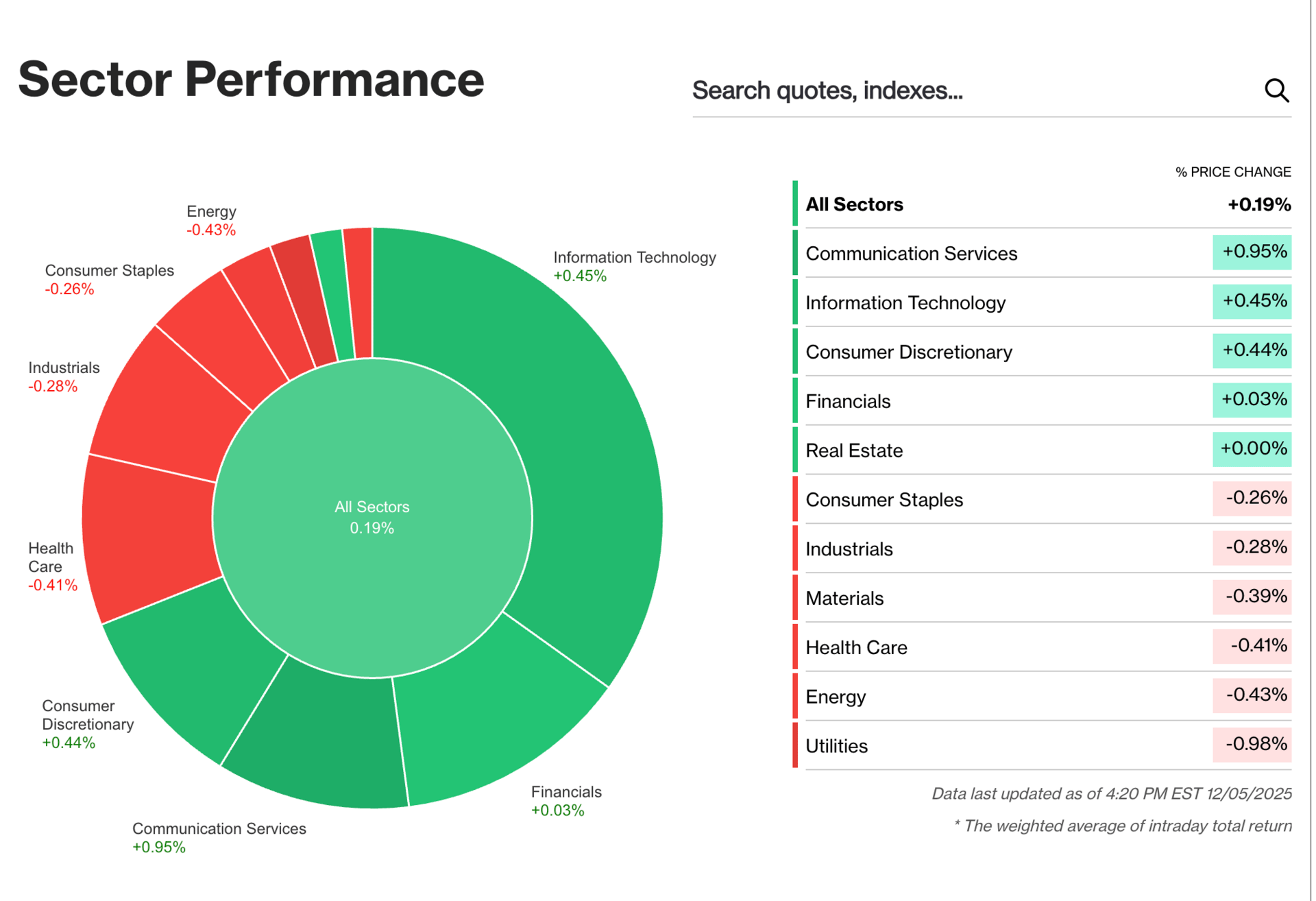
Happy Friday, the market is climbing after inflation data showed just the slightest uptick in September from the month before. Of course, September feels like last year at this point, but still, it’s the last big data the FOMC has to go on, and betting charts paint a pretty picture for a labor market-focused rate cut next week.
CME FedWatch shows an 87% chance for a 25 basis point cut, or a 0.25% reduction to a target rate towards 3.50-3.75. Friday, overnight Federal Funds rates were closer to 3.89%, according to the New York Fed — it’s just a target after all.
Rate cut hopes were helped along by Michigan consumer sentiment Friday morning, which showed the first positivity in about five months, a sign that it’s hard to remain grinchy near the holidays. It feels like between all the gift buying and family circuterie board planning, everyone just keeps their trades in place until January, so what reason is there for stocks to fall?
The real major news was Netflix winning the bid to buy Warner Bros, and the question of whether Trump will let them do it.
AFTER THE BELL
The Who’s Who Of New Names On The S&P 500
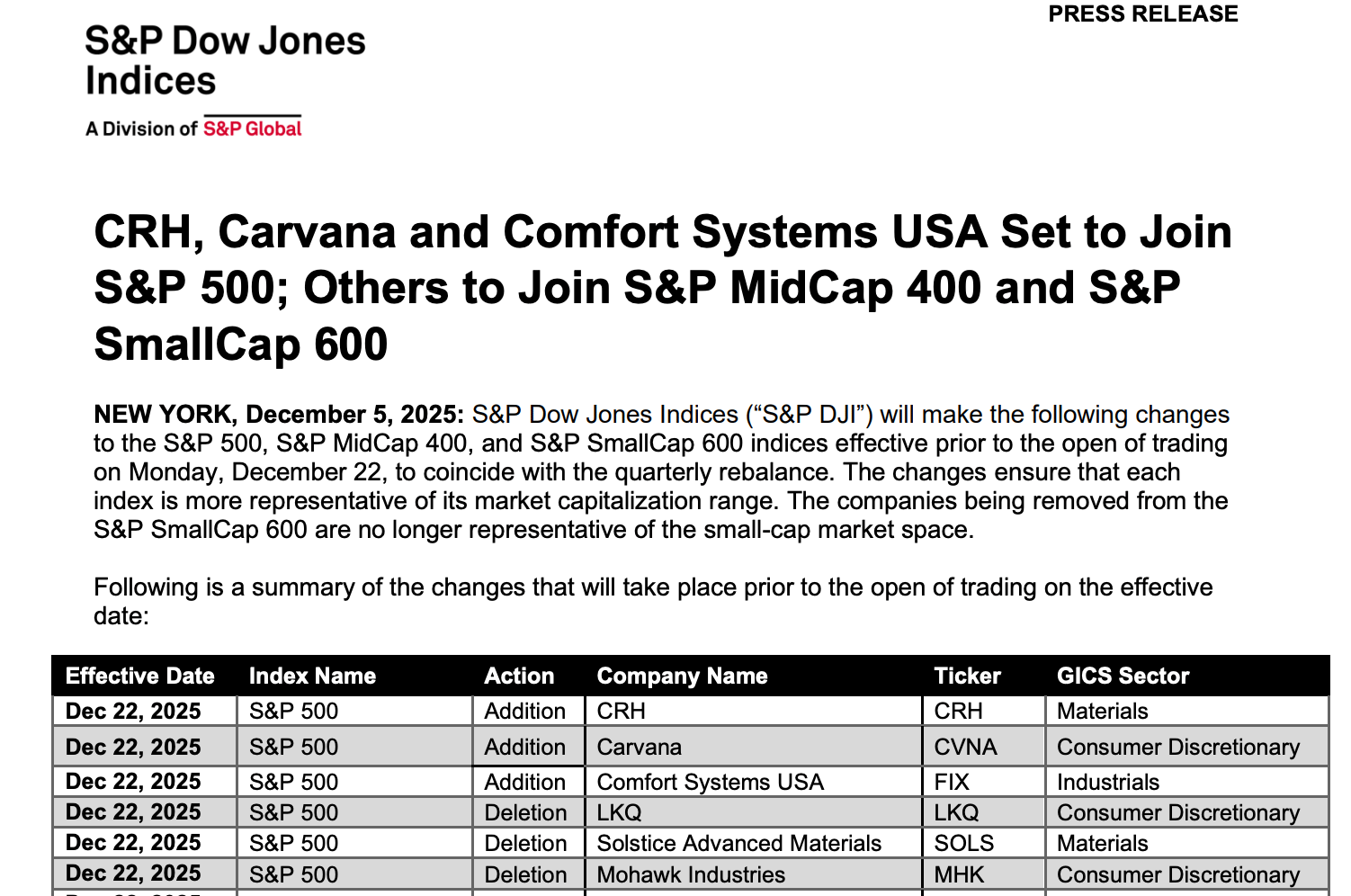
S&P Dow Jones Indices announced major changes to the S&P 500, S&P MidCap 400, and S&P SmallCap 600 indexes, after the bell Friday. The new names will come in prior to the opening bell on Monday, December 22, 2025. The lister said these changes ensure the indices accurately reflect their respective market capitalization ranges.
The most significant moves are the additions to the S&P 500:
CRH $CRH ( ▼ 1.29% ) (Materials):The global building materials company is being added, signaling strength in the construction and infrastructure sector.
Carvana $CVNA ( ▲ 0.23% ) (Consumer Discretionary): The online used-car retailer's addition marks a remarkable recovery story after its stock surged from low points earlier in the year, justifying its entry into the large-cap index.
Comfort Systems USA $FIX ( ▼ 0.32% ) (Industrials): The national provider of mechanical, electrical, and plumbing services is joining the large-cap index, highlighting momentum in industrial and commercial services.
These additions will necessitate billions in buying activity from passive funds that track the S&P 500, a move often referred to as a "buy program."
S&P 500 Deletions
To make room for the additions, the following companies are being removed from the S&P 500:
LKQ $LKQ ( ▲ 2.01% ) (Consumer Discretionary)
Solstice Advanced Materials $SOLS ( ▲ 0.36% ) (Materials)
Mohawk Industries (The third deletion will be confirmed by S&P DJI.)
DEAL NEWS
It’s All Coming Up Netflix
Netflix $NFLX ( ▼ 2.89% ) won the Bid for $WBD ( ▲ 6.28% ) with a $72B equity buyout, valuing the movie studio and streaming portion of the Warner Bros empire at $27.75/share. Hours after I wrote about the competing deals last night, the board approved Netflix's proposal.
That means Netflix is buying HBO titles, beating out Comcast and $PSKY ( ▼ 9.82% )in the deal! Netflix and WBD pulled in $39B in revenue last year, now planning to combine streaming services HBO MAX and IPs like DC comic superhero movies under the Netflix umbrella.
WBD is still spinning out its network TV brands under the deal, so properties like CNN will head off into the world under a separate ticker, while movies and streaming head over to Netflix.
$PSKY ( ▼ 9.82% ) was falling on the news, leading the low end of the S& 500, but have no fear, Paramount shareholders, big government is here!
Turns out the deal is not a sure thing, even under the merger-supporting Trump administration. David Ellison, chief of the newly combined Paramount Skydance, has a rich daddy: $ORCL ( ▲ 1.52% ) boss, Larry Ellison. The Ellisons are long-time Trump supporters. Reps from Paramount met in the White House this week, arguing their case, according to industry reports.
Para lawyers have argued in letters ot the WBD board that Netflix, flush with tech streaming cash, is not a good option for a realistic merger- its international reach makes publishing far to complicated.
The company still has other options, besides complaining to the White House. CNBC reported Para bidders might pitch directly to shareholders of WBD that their deal is better, or sue the board for allegedly not fairly considering its $30/share bid.
An admin spokesperson said they were heavily skeptical that regulators will approve the massive merger, according to CNBC.
MACRO NEWS
What Is The Minimum Income For A Family Of Four?
Welcome back to another edition of Friday vibessetion talk, where I review how readers responded to the question: is the poverty line nearer to $30k, or $140k?
Rewinding the clock, remember that Michael Green, Strategist and Portfolio Manager for Simplify Asset Management. wrote before Thanksgiving he thought the actual ‘poverty line’ in the U.S was much higher than we thought.
Others argued against his claim, as Green summarized and again retorted this week. He pointed out a concession that his $140k metric is a number estimating cost of living in Essex County NJ,. Strike one for the critics.
Green wrote a more ‘fair’ county to pick a cost of living average from, say Lynchburg, VA, with a $94k cost of living, is still 3X the poverty line.
In any case, Green continued to argue that the real point he wanted to make is that American life is prohibitively expensive.
He also pointed out that some arguments made against his calculations were more focused on ‘but actuallying’ his work than participating in ‘things are super expensive’ dialogue, but I’ll leave that to him.
I put the question to my audience Monday, and here are the results:
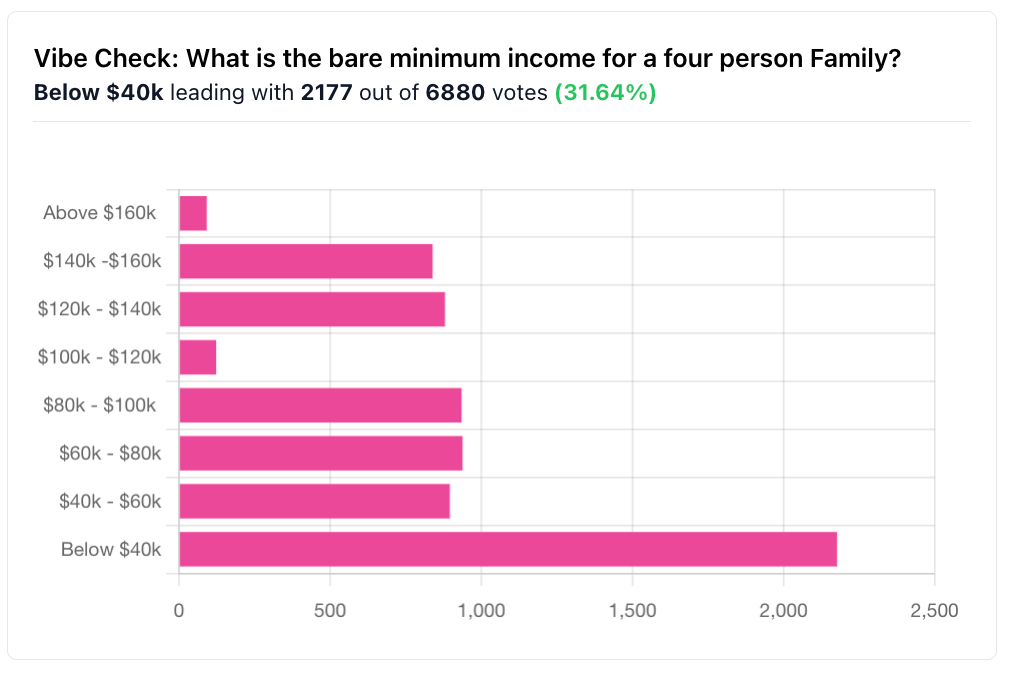
Looks like a full third of respondents saw the Federal Government’s ~$30K mark as the bare minimum. At first glance, this looks like it supports detractors of Green, that the poverty line is the poverty line, nothing to see here.
But on its head, the results show that vast majority of these Daily Rip readers feel that the bare minimum to make it as an American family is above the ‘standard’ poverty line.
If taken together, the majority is skewed to in between the 31k-120k range. More than one out of four readers sees the bare minimum line above $122k.

Source: Stocktwtis The Daily Rip Survey baby!!
First Quartile (Q1): $31.60k. This means 25% of voters believed the bare minimum income should be at or below this amount.
Median (Q2): $67.83k. This is the midpoint, meaning half of voters believed the income should be at or below this amount.
Third Quartile (Q3): $122.07k. This means 75% of voters believed the income should be at or below this amount.
POPS & DROPS
Top Stocks News Stories
President Trump greenlit the domestic production of "tiny cars"like Asia's kei cars, citing them as amazing, safe, and fuel-efficient.
Smith & Wesson stock rose 5% after its upbeat Q2 earnings beat estimates.
Silver blasted above $59, extending its record rally, which has doubled prices this year.
Apple's executive exits may signal concerns over the company's long-term design vision and the search for its next major breakthrough product.
Ulta Beauty had a "glow-up" year with a new CEO, fresh strategy, and steady stock growth
Cloudflare experienced a global outage that hit several websites today after a change to its Web Application Firewall.
The Trump administrationexpressed heavy skepticism regarding the Netflix and Warner Bros. Discovery deal.